
"Peruvian coffee origins"
400 article(s) found

The taste of Peruvian coffee is smooth and smooth. Introduction to the characteristics of fine coffee beans in the manor area.
In 1542, the Spanish royal family set up the Government House in Lima and established the Governor's District of Peru, which became the center of Spanish colonial rule in South America. At that time, Peruvian commerce was prosperous, merchants controlled most of South America's import and export trade, and the precious metals and other goods looted by the Spaniards from South America were shipped out of Peru. The colonists encroached on land in Peru, forced the Mita system, and forced the Indians to

Introduction of Peruvian boutique coffee bean flavor and taste manor area
Independence was declared on July 28, 1821, and the Republic of Peru was established. On October 28, 1835, Bolivia and Peru formally merged, known as the Confederacy of Peru and Bolivia. On February 20, 1839, the Confederacy completely disintegrated. Slavery was abolished in 1854. From 1879 to 1883, Peru joined Bolivia and Chile in the South American Pacific War for saltpeter production. After Peru's defeat, Chile captured the world.
Peruvian cicada tea Mayou coffee bean boutique coffee bean technology
Up to 98 per cent of Peruvian coffee is grown in forest areas, most of the producers are small farmers, and Peru's best coffee is produced in several regions, such as Chanchamayo, Cuzco, Norte and Puno. Most Peruvian coffee is grown under natural conditions, but it is also difficult to confirm the cultivation of all coffee trees. Natural condition

American Coffee Manor Peruvian Coffee beans have sweet nutty flavor.
Up to 98 per cent of Peruvian coffee is grown in forest areas, most of the producers are small farmers, and Peru's best coffee is produced in several regions, such as Chanchamayo, Cuzco, Norte and Puno. Most Peruvian coffee is grown under natural conditions, but it is also difficult to confirm the cultivation of all coffee trees. Natural condition
Peruvian cicada tea Mayou coffee beans basic knowledge of coffee beans
Up to 98 per cent of Peruvian coffee is grown in forest areas, most of the producers are small farmers, and Peru's best coffee is produced in several regions, such as Chanchamayo, Cuzco, Norte and Puno. Most Peruvian coffee is grown under natural conditions, but it is also difficult to confirm the cultivation of all coffee trees. Natural condition

Where is Peru? Peruvian coffee beans describe the flavor characteristics of varieties
A rising star in the coffee industry, Peru Coffee Geography Peru is located in western South America, covering an area of 1285216'2. It is bordered by Ecuador and Colombia to the north, Brazil to the east, Chile to the south, Bolivia to the southeast and the Pacific Ocean to the west. The coastline is 2254 kilometers long. Peruvian coffee is a rising star in the coffee industry. Peruvian coffee is at a temperature of 1826 degrees and annual precipitation of 7001. 50.

Rich and sweet Peruvian coffee flavor description introduction to the grinding degree of fine coffee varieties
Mount Coropuna and Mount Salcan are both more than 6000 meters above sea level, while Mount Vascalan is 6768 meters above sea level, the highest point in Peru. The main rivers are the Ukayari River and the Putumayo River. The southern part of the central part is volcanic with frequent earthquakes, and Lake Titicaca, which is the second largest lake in South America, lies on the southeast border with Bolivia. The northern part of the center contains oil along the coast and offshore. Rich anchovy off the coast (Peru

Peruvian coffee producing area boutique coffee culture coffee bean market coffee network
Peru (Peru) is also a big coffee producer. Peruvian coffee producing areas: up to 98% of Peruvian coffee is grown in forest areas, and most of the producers are small farmers. Peru's finest coffee is produced in Chanchmayo, Cuzco, Norte and Puno. Most Peruvian coffee is grown under natural conditions, but it is also difficult to determine

Coffee producing areas in Peru
Peruvian coffee producing areas: up to 98% of Peruvian coffee is grown in forest areas, and most of the producers are small farmers. Peru's finest coffee is produced in Chanchmayo, Cuzco, Norte and Puno. Most Peruvian coffee is grown under natural conditions, but it is also difficult to confirm the cultivation of all coffee trees. Under natural conditions

Peruvian coffee producing area
Peru (Peru) is also a big coffee producer. Up to 98% of Peruvian coffee is grown in forest areas, and most producers are small farmers.

Peruvian Coffee Flavor description characteristics of Grinding degree introduction of Fine Coffee beans in producing areas
In 1542, the Spanish royal family set up the Government House in Lima and established the Governor's District of Peru, which became the center of Spanish colonial rule in South America. At that time, Peruvian commerce was prosperous, merchants controlled most of South America's import and export trade, and the precious metals and other goods looted by the Spaniards from South America were shipped out of Peru. The colonists encroached on land in Peru, forced the Mita system, and forced the Indians to
Coffee producing area Coffee introduction Peruvian Coffee
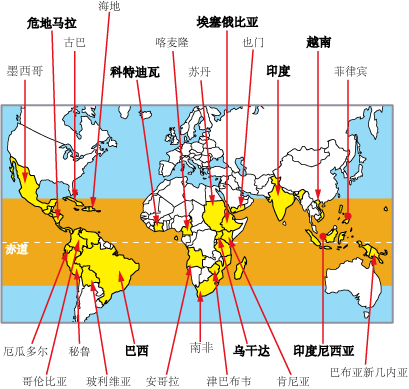
Coffee is high-quality and balanced and can be used for mixed drinks. Peru (Peru) is also a big coffee producer. Up to 98% of Peruvian coffee is grown in forest areas, and most producers are small farmers. Peru has good economic conditions and a stable political situation, thus ensuring the good quality of coffee. However, there are many local problems, in addition to guerrilla warfare and drug trafficking, in the 20th century
Coffee producing area 53 coffee producing areas in the world Peruvian coffee from Peru
Peru Peruvian coffee is high quality and balanced and can be used for mixed drinks. Peru (Peru) is also a big coffee producer. Up to 98% of Peruvian coffee is grown in forest areas, and most producers are small farmers. Peru has good economic conditions and a stable political situation, thus ensuring the good quality of coffee. However, there are many local problems, except guerrilla warfare and drug trafficking.

Taste characteristics of Peruvian coffee with smooth taste introduction of fine coffee beans and organic coffee
In 1542, the Spanish royal family set up the Government House in Lima and established the Governor's District of Peru, which became the center of Spanish colonial rule in South America. At that time, Peruvian commerce was prosperous, merchants controlled most of South America's import and export trade, and the precious metals and other goods looted by the Spaniards from South America were shipped out of Peru. The colonists encroached on land in Peru, forced the Mita system, and forced the Indians to

Coffee quality balance, can be used to mix drinks Peruvian coffee boutique coffee
Boutique coffee is fresh coffee. Whether it's food or drink, of course, the fresh the better, and so is boutique coffee. High-quality coffee should keep the coffee beans fresh before making, including the preservation of baked beans, and grind the coffee beans into powder before making, which is also to retain its original and best flavor. And the way of making hand-made coffee is such a way to make high-quality coffee.

Introduction to the mild taste of high-quality coffee beans in Peruvian coffee producing areas
In 1542, the Spanish royal family set up the Government House in Lima and established the Governor's District of Peru, which became the center of Spanish colonial rule in South America. At that time, Peruvian commerce was prosperous, merchants controlled most of South America's import and export trade, and the precious metals and other goods looted by the Spaniards from South America were shipped out of Peru. The colonists encroached on land in Peru, forced the Mita system, and forced the Indians to

Introduction to the taste of Peruvian single bean flavor description, planting and development history of producing areas
For the exchange of professional baristas, please follow the coffee workshop (Wechat official account cafe_style) today to introduce the characteristics of coffee beans from Peru, an ancient civilization. To put it simply: 1. It is internationally certified as organic coffee bean 2. Decaffeinated Peru is best known for its coffee beans from Mangcha Mayou in the middle and Cusco in the south. In addition, there are some in the north of Peru.

Peruvian Andes Gold Organic Coffee
Professional coffee knowledge exchange More coffee bean information Please pay attention to coffee workshop (Weixin Official Accounts cafe_style) Peru is located in the west of South America, with a coastline of 2254 kilometers. The Andes runs through the north and south, and the mountains account for one third of Peru's total area. The climate is dry and mild. Ninety-eight percent of Peruvian coffee is grown in the jungle at the foot of the Andes. Chassimayo in central Peru

A brief introduction to the description of the flavor, taste and aroma characteristics of high-quality Peruvian boutique coffee
Peru has good economic conditions and a stable political situation, thus ensuring the good quality of coffee. However, there are many local problems, in addition to guerrilla warfare and drug trafficking, the emergence of cholera along the coast in the mid-1990s led to a further economic depression, and what is more, the annual inflation rate reached 7000%. In the mid-1970s, Peru produced about 9 percent of its coffee a year.